

The short answer
- Median: about 59–66 days for a new daily behavior to become automatic.
- Range: from under three weeks to almost a year, depending on the person and the habit.
- Missing one day does not reset progress. Consistency over weeks matters more than a perfect streak.
What the research says
The 66-day study (Lally et al., 2010)
Researchers at University College London asked 96 volunteers to pick one eating, drinking, or activity behavior and repeat it daily in the same context—for example, “after breakfast”—for 12 weeks. Participants rated how automatic the behavior felt each day.
Among participants whose data could be modeled, the median time to reach 95% of their maximum automaticity was 66 days, with individual results ranging from 18 to 254 days. Automaticity rose quickly at first and then leveled off. Simple behaviors, such as drinking water, tended to become automatic sooner than more demanding ones, such as exercise. Read the study.
The 2024 systematic review (Singh et al.)
A review from the University of South Australia combined 20 studies with 2,601 participants covering behaviors such as physical activity, healthy eating, flossing, and drinking water. It found median formation times of 59–66 days, mean times of 106–154 days, and individual times from 4 to 335 days. Read the review.
Where the “21 days” myth comes from
The 21-day idea traces back to Psycho-Cybernetics (1960) by plastic surgeon Maxwell Maltz. He observed that patients needed “a minimum of about 21 days” to adjust to changes like a new appearance. That was an observation about adjusting to change, not a study of habits—and over time “a minimum of about 21 days” was shortened to “21 days to form a habit.”
What changes how long it takes?
- Difficulty: drinking water after breakfast is simpler than completing a long workout.
- Frequency: behaviors repeated often provide more opportunities to learn the cue-response pattern.
- Stable context: the same time, place, or preceding action makes the cue easier to recognize. The 2024 review found consistent context linked to stronger habits.
- Time of day: in one study included in the review, stretching habits grew stronger when practiced in the morning than in the evening.
- Choice: habits people chose for themselves were more successful than assigned ones.
- Enjoyment: behaviors people enjoy tend to become habits more easily.
- Planning: a specific “when and where” plan, such as a habit stack, supports automaticity.
Typical timelines by habit type
These are rough expectations based on the research above, not guarantees:
- Very simple, daily, cue-linked (a glass of water after breakfast, taking a vitamin after brushing): often a few weeks to about two months.
- Moderate (a 10-minute walk after lunch, reading before bed): commonly around two to three months.
- Demanding or less frequent (gym workouts, a new diet, early wake-ups): can take several months or longer.
Signs a habit is becoming automatic
You begin with less deliberation, remember the behavior when its cue appears, and need less motivation to start. Consistency often improves before the action feels fully automatic, so both completion history and perceived effort matter.
How to help a habit stick faster
- Make the first version small and specific.
- Choose a cue that already occurs reliably—stack it onto an existing habit.
- Do it at the same time and place, ideally earlier in the day.
- Pick a habit you actually want and make it enjoyable.
- Reduce preparation before the action.
- Track repetitions without treating one miss as failure.
- Review the pattern after a few weeks and adjust the environment when necessary.
Track a trend, not a countdown
A fixed countdown can create a false finish line. HabitForm instead combines your completion pattern and habit difficulty into a formation probability and an estimated days-to-automatic that update as your real behavior changes.
FAQ
Does it take 21 days to form a habit?
No. The number comes from a 1960 self-help book, not habit research. Studies show most habits take longer—around two months on average, with wide variation.
Does missing a day ruin a habit?
No. In Lally’s study, missing a single opportunity did not meaningfully affect the formation process. Get back to it the next day.
How many repetitions does it take to form a habit?
There is no fixed repetition count. Habits strengthen with repetition in a stable context, so simple daily behaviors usually become automatic sooner than complex or infrequent ones.
How long does it take to break a habit?
There is less research on breaking habits, and no reliable fixed number. Changing the cues and environment that trigger the old behavior, and replacing it with a new routine, usually works better than willpower alone.
Watch your habit become more consistent
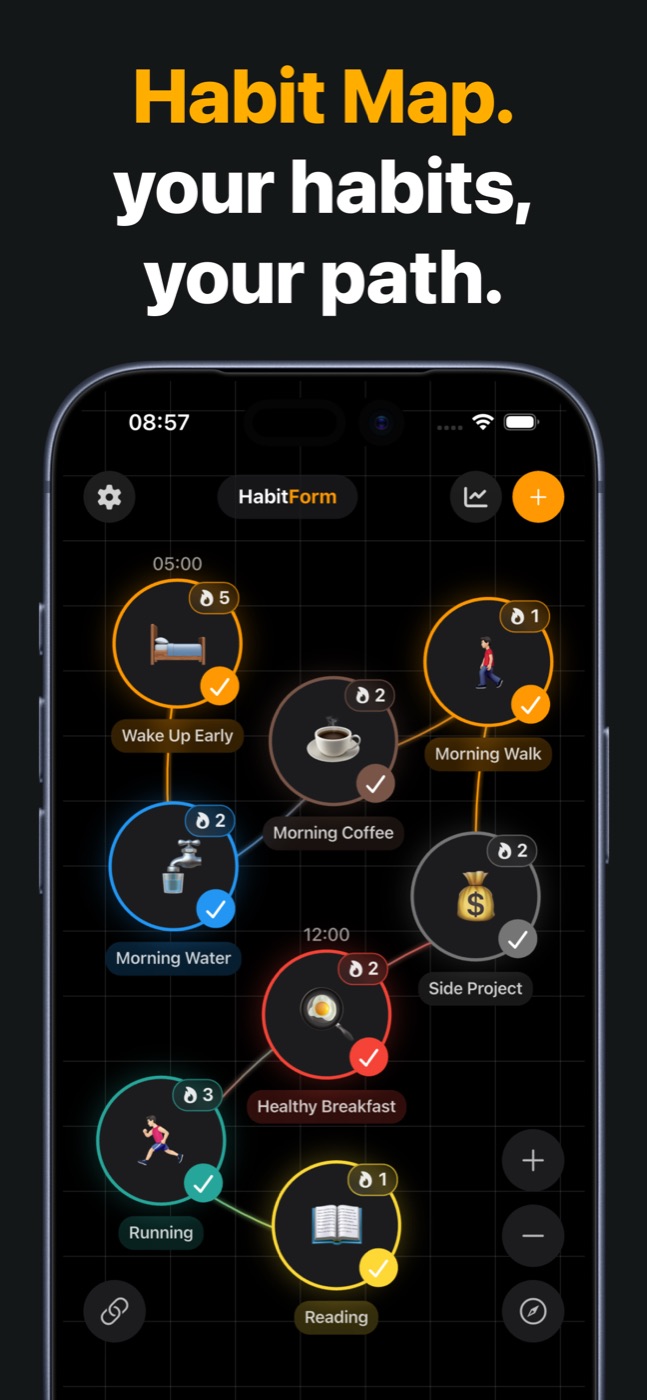
Track repetitions, see formation insights, and keep your daily routine visible with HabitForm.


Keep reading
- Estimate your own habit formation timeline
- Habit stacking: meaning, formula, and 30 examples
- Visual habit tracker: how a habit map shows your routine
- How to choose a habit tracker app you will actually use
Sources
- Lally, P., van Jaarsveld, C. H. M., Potts, H. W. W., & Wardle, J. (2010). How are habits formed: Modelling habit formation in the real world. European Journal of Social Psychology, 40(6), 998–1009. doi:10.1002/ejsp.674
- Singh, B., Murphy, A., Maher, C., & Smith, A. E. (2024). Time to form a habit: A systematic review and meta-analysis of health behaviour habit formation and its determinants. Healthcare, 12(23), 2488. PMC11641623
- Maltz, M. (1960). Psycho-Cybernetics. Prentice-Hall.
Published August 13, 2026 · Updated September 22, 2026 · HabitForm